Viktoria Urban
Stories & Writing
Why waveL art?
waveL art is founded on the conviction that art needs more than visibility. It needs intelligence, context, and spaces where meaningful exchange can unfold. In this conversation, Markus reflects on why waveL art was created, how storytelling and networks define its approach, and why reflection has become essential in a fast-moving and increasingly noisy world. The interview offers insight into the thinking behind waveL art and its ambition to build a living ecosystem around art, ideas and people rooted locally, yet connected globally.
waveL art has just been launched. Why did you feel the need to create it now?
waveL art is a natural evolution of what we have been doing for years. We have worked at the intersection of intelligence, storytelling, and networks, across countries, languages, and cultures, translating complex ideas into meaningful narratives. We need reflection, not only reflex. The art world operates under similar conditions. We need time, depth, dialogue, and the ability to move thoughtfully across borders and disciplines. waveL art was created to offer exactly that: a platform where art, ideas, and people can meet, locally grounded, yet internationally connected. Our experience of working in multiple languages and cultural environments allows us to engage with art not as a closed system, but as a living, transnational conversation that evolves through exchange, translation and encounter.
What does storytelling mean in the context of art?
Storytelling is not about simplifying or explaining art away. It is about creating narratives that allow connection. Artists, curators, galleries, collectors, institutions, and businesses, scientists, innovators and educators all want to relate, to understand context, to tell stories. In this interconnected and globalised landscape, strong narratives help art travel beyond niches, borders, silos and closed circles. They enable resonance without loss of complexity. Our role is to listen, to spend time with the key players, and to translate artistic practices into compelling stories that engage intellectually and emotionally. This is where our international experience becomes particularly valuable: we understand how meaning shifts between contexts, and how stories can remain authentic while speaking to different cultural sensibilities.
waveL art places strong emphasis on intelligence and reflection. Why is that so important to you?
We are surrounded by noise, speed, and instant reflexes instead of reflection. What is increasingly missing and desired is food for thought. Intelligence, in our understanding, is curiosity, openness, and the willingness to reflect. Art is a space where this kind of intelligence can unfold. With waveL art, we want to cultivate physical and virtual environments where dialogue, debate, and sophisticated thinking are actively encouraged. This requires slowing down, attentiveness, a good planning and a respect for different cultural rhythms, histories, and perspectives.
Networks are another key pillar of waveL art. How do you approach them?
We see ourselves as connectors and orchestrators. We bring people together who might not naturally meet, but who can inspire each other profoundly: artists with entrepreneurs, curators with scientists, collectors with educators. Through events, curated gatherings, workshops, and conversations, both physical and virtual, across different cities and cultural contexts, we create spaces where ideas circulate and new collaborations emerge. These networks grow organically through trust, shared curiosity, and intellectual generosity. They attract like-minded people who want to contribute, not just consume.
What is your ambition for waveL art going forward?
Our ambition is to grow waveL art into a living ecosystem. We’re also launching waveL lab, a laboratory, a forum, and a think tank for exchange, reflection, and community building. I’m sure we will all be surprised how creative and productive this platform can be. It is designed as an open space for long-term thinking, experimentation, and collaboration. We want waveL art to be a place where art is not only shown, but discussed, questioned, connected, and activated. Ultimately, it is about bringing art closer to people and giving it the narratives and platforms it deserves while allowing it to travel meaningfully between cultures and contexts.
Why is Athens the headquarters of waveL art?
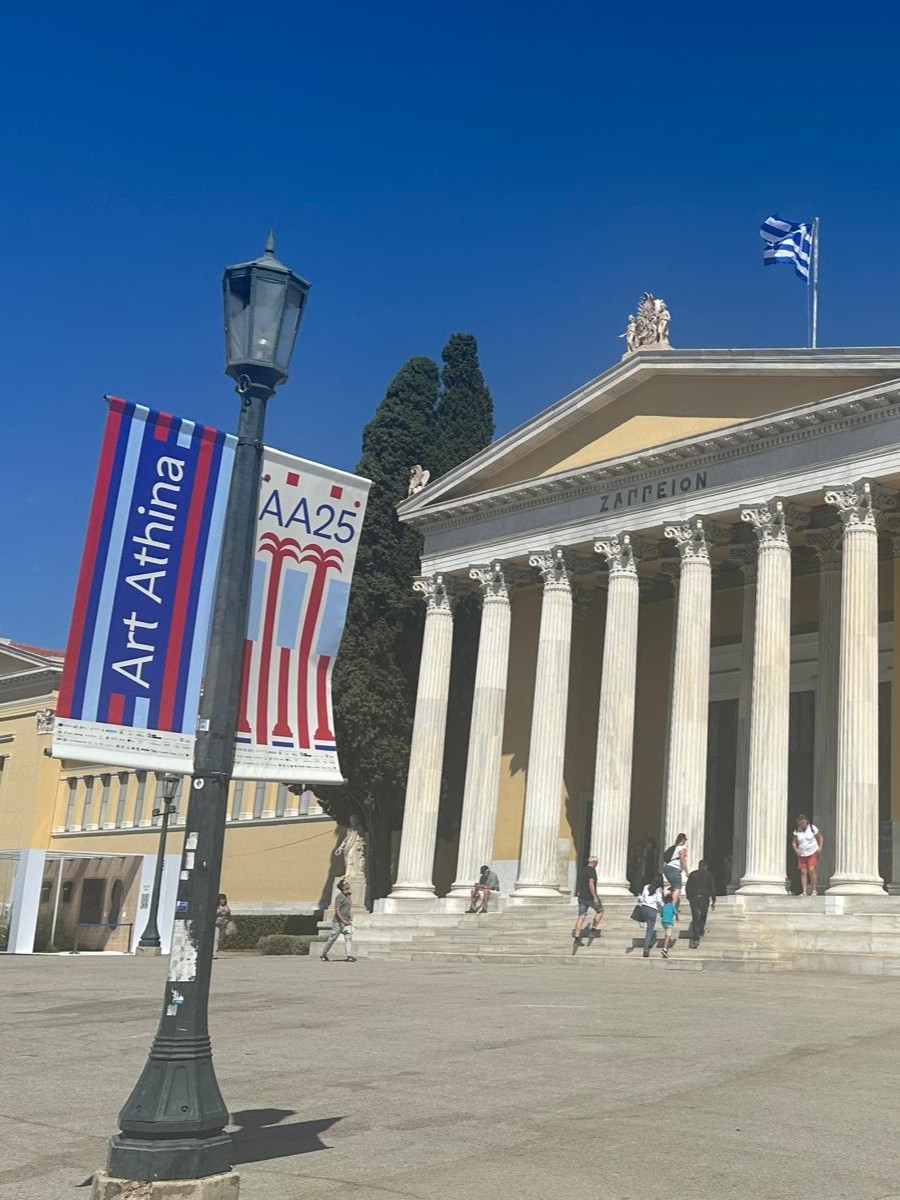
waveL art is anchored in both Athens and Luxembourg. Luxembourg is my home country and where waveL has its deep European roots. Athens, on the other hand, has an enormous energy and attraction; it’s a melting pot that embodies a powerful tension between continuity and reinvention. It is a city shaped by extraordinary intellectual and cultural depth, while remaining a place of contemporary experimentation, friction, and constant transformation. Athens invites waveL art to negotiate the balance between historical awareness and creative urgency. Geographically, intellectually, and culturally, it is also a crossroads between Europe, the Mediterranean, and the Orient. This makes it an ideal place to ground waveL art’s reflective and international ambition, and mirror it into the centre and North of Europe.
At the same time, waveL art is not confined to one place. With an active presence in Porto in Portugal, Glasgow in Scotland, Berlin, Frankfurt and Munich in Germany, Aix-Les-Bains and Paris in France, and of course Luxembourg, and with links to the Middle East, U.S., and Asia, we are embedded in diverse artistic, cultural and economic ecosystems. This allows us to connect, work across contexts and scales, build bridges and create synapses from which new ideas, inspirations, partnerships and dynamics can emerge.