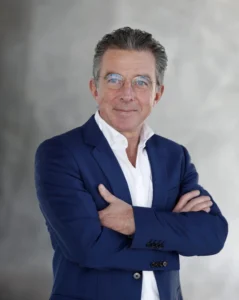
Markus Payer
Founder & Director
This is a question we have been frequently asked since we launched waveL art.
Our answer is simple: storytelling brings people together. It creates connections, draws the large arcs, and reveals the bigger picture. As a professional discipline, it enables communication — in politics, economy, and culture. It allows us to establish coherent narratives, structure our engagements with others, pursue long-term strategies and share enduring visions. Storytelling helps us rise above the banal exchange of clichés, the lowest common denominators of communication and the fleeting reflexes of fast turnover digital platforms.
Some might argue that artworks need no words – or very few. Yet we need language to develop our thoughts about them, express and exchange ideas, and give complex facts, emotions, and experiences a form. We need texts and context to think; semantics and syntax to express ourselves; narratives and structure to transform intuitive moments into poetic fabric or epic tapestry. Like music, storytelling elaborates leitmotifs and variations, inviting improvisation and modulation. Storytelling is dialogue, and dialogue requires structure, planning and orchestration.
That’s our job. Professional storytelling demands insight, patience, empathy, and understanding. It is not an instinctive reflex but a process of careful reflection. It relies on intelligence, culture, and the principles of composition. It builds on analysis, and depends on formulation. It requires a methodology.
“Our job is to tell your story”. What does that mean in practice? How can we describe the methodology we have developed at waveL to manage communication in sophisticated high-tech industries such as space, semiconductors, and biotechnology? What do we want to bring from this experience to the arts, with waveL art?
It begins with analysis. We seek to understand the DNA of an organization, entity, or artwork: its strengths and weaknesses, harmonies and disruptions. By analyzing a personality, a brand, or an artistic practice, we identify its core attributes and find the key terms which help us decipher its grammar and discover its profile as a unique way of expressing itself and distinguishing it from others.
The next step is projection. We extend the characteristics and facial features into the future and formulate a vision, a mission, and a raison d’être. We ask not only who the organization or personality is today but who it aspires to become. And we record this narrative in what we call the Storybook.
The Storybook is the central narrative, the blueprint or ‘bible’, from which all subsequent chapters and stories can be developed and modulated for different audiences, contexts, or purposes. It is the guide we carry with us when we step onto a stage, attend an event, meet multipliers or partners, or write an essay, a catalogue contribution, or a post for social media. It is like the recipe: when the ingredients and their preparation are clear, the result is not a surprise or a lucky strike but a precise and professional communicative outcome.
This is what we call strategic communication: a structured approach based on analysis, a messaging matrix, tools, and intelligence. Storytelling is the opposite of the notion that Public Relations consists of name-dropping and champagne receptions. Or – as we like to put it – “doing something with elephants”.
We ask what we call the Hannibal question: do we simply want to do something with elephants, or do we want to cross the Alps, which requires a plan, a roadmap, a navigator, ammunition, provisions, patience, and a clear sense of direction.
At waveL, this is the journey we have chosen.