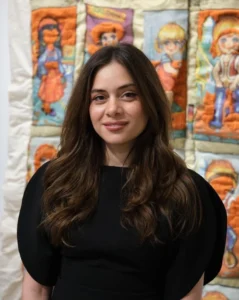
Mariandrie Chrysostomou
Visual Artist
I first encountered Vasilis Galanis’s work in person in the debut group exhibition at Upper Ankyle. Later during a visit to his studio at Petrolana, I was introduced to Doom Scrolling, an ongoing collaborative series with Fiona Elli Spathopoulou. The project immediately captured my attention. I found myself drawn to its inventive use of engraved tablets, laptops, and other contemporary screens, objects so deeply embedded in our daily lives that they often escape critical reflection.
Curious to learn more about the ideas, processes, and collaboration behind the series, I spoke with both of them in the following short interview.
What is your inspiration for the Doom Scrolling series? Was it a response to a particular moment in contemporary culture, your own media habits, or a broader reflection on how we process information today?
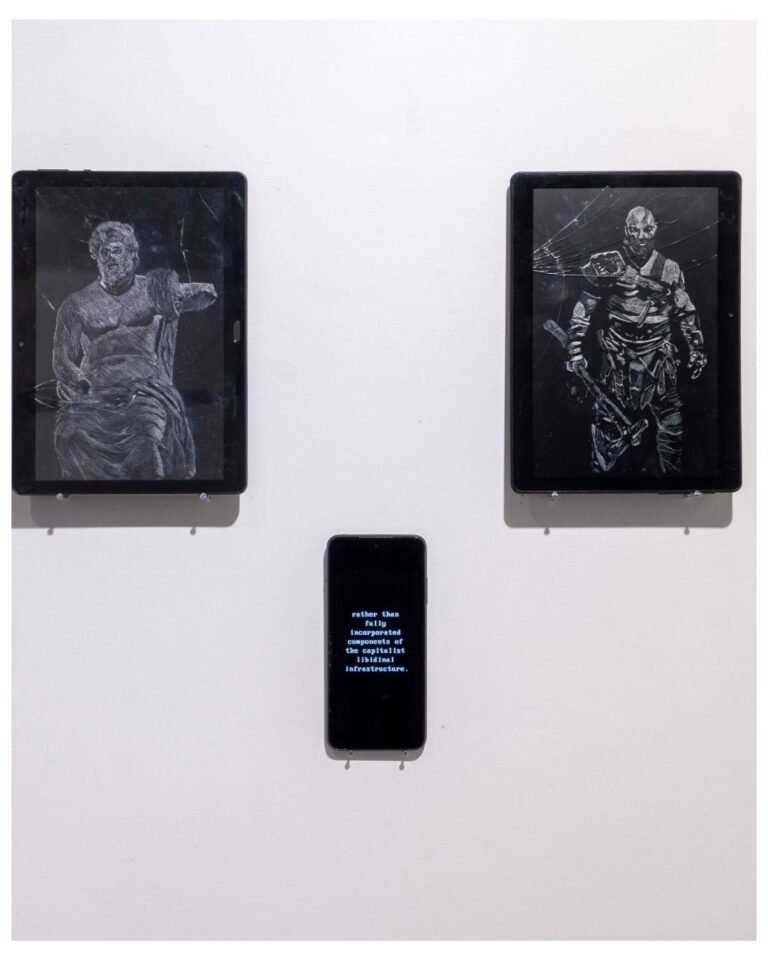
The series grew out of our first collaborative work, Hands-Up, an installation combining two engraved tablets and a video on a mobile phone, in which we brought together an archaic figure and a popular video game hero, Kratos from God of War. That piece was our first attempt to put two very different visual languages in dialogue around a common subject: war.
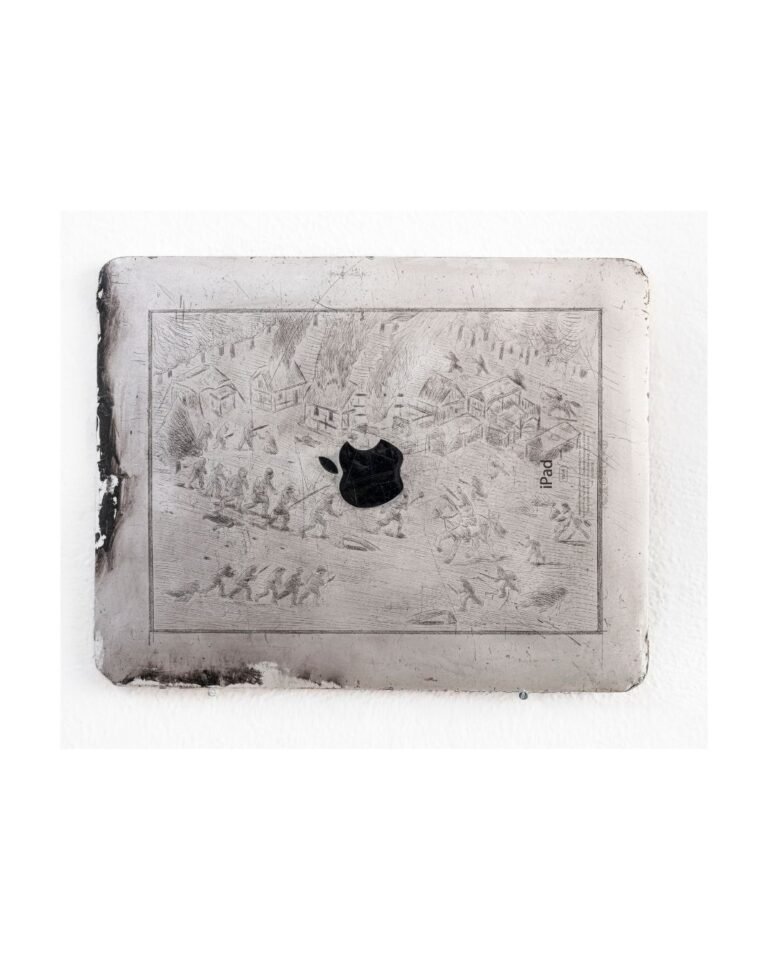
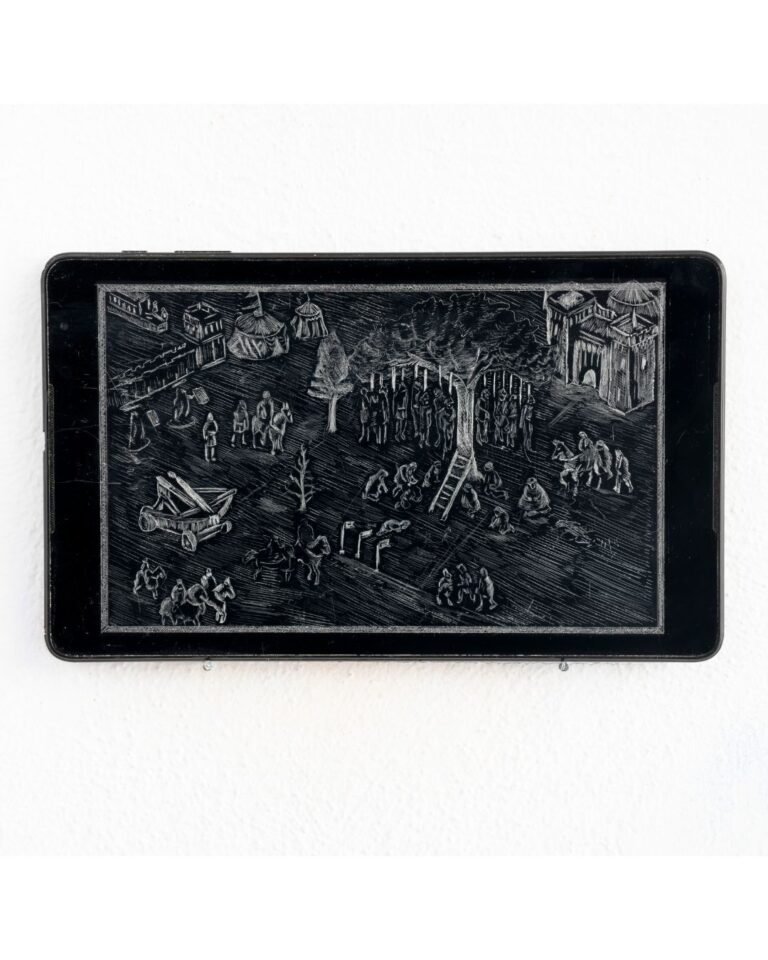
With Doom Scrolling we wanted to explore this further, by translating Jacques Callot’s etching suite The Grand Miseries of War into the digital visual language of Age of Empires II. On the surface they may seem to share little, but looking closer at Callot’s etchings what stands out is not the combat itself but the villages razed, the buildings burned, the civilian infrastructure swallowed by war. That is precisely the texture of Age of Empires too, and where the two worlds start to speak to each other. Doom Scrolling questions the fleeting nature of images on screens, but freezes them in a specific moment of action, which is also, literally, what the engravings do: they fix a scene of conflict onto the very devices we use to consume it.
There wasn’t so much a specific moment that inspired the series, but rather this intensification of global crises that manifested themselves in our screens, co-relating with a worsening of our media habits, i.e. doomscrolling. Contrary to the whole rhetoric of the information super-highway and the techno-optimism of the 90’s, we think that, in the present context, a lot of people feel overwhelmed with this surplus of information we have, literally, in our hands. It’s that psychological dimension, alongside the historical one, that the series is mostly about.
Video games allow people to build identities, relationships, and narratives inside virtual spaces. Are the game references intended as a commentary on escapism, community, or another aspect of contemporary life?
Firstly, we would like to say that we view video-games as a very interesting mixture of both escapism and community building. This is perhaps why so many seek refuge in such virtual spaces where it can feel easier to exist and relate to. And yet that refuge is very often a battlefield. The aesthetic of escape and the aesthetic of atrocity become sometimes almost indistinguishable.
Secondly, we believe contemporary life and experience, in their totality, are way more game-y than 50 or 100 years earlier. It stands as a logical assumption that in a world where everything is simulated in order to be predicted and controlled, from weather forecasts to the stock market and contemporary warfare, the line between games and reality gets increasingly blurred. So we would say that, mostly, the game references point to that aspect, the more things come under the illusion of control, the more gamified they feel. If you have grown up playing the Sims, it’s not very strange to sometimes feel the little diamond on top of your head changing colors.
I see an interesting tension between the traditional technique of engraving and the contemporary subject matter of digital media. What motivated you to combine such a historical printmaking language with themes of screens, technology, and online consumption?
There is a tension, indeed. It may have something to do with our generation, growing up at this exact tension between the analog and digital worlds. However these transitions never happen smoothly or totally.
Images, motifs and themes survive and mutate throughout centuries. Jacques Callot documented the Thirty Years’ War with the obsessive precision of someone who felt compelled to make the horror legible, plate by plate, figure by figure. In that sense, his impulse is not so different from someone who opens the Age of Empires II Scenario Editor to build their own map or campaign. As McLuhan put it, the content of one medium is always a previous one. What we do is simply point to that survival, opening up this babushka of media within media.
Lastly, it is also a homage to the futility of art as the work deprives both the screen and the etchings of their potential usages. By etching the screen, it becomes useless as a screen as it can no longer transmit images, and as an etching on such a fragile surface, it is doomed to never be printed.